Note Energy Flipping
(This is a continuation of a separate article.
Please read that before continuing.)
Thus far, energy charts for notes have been depicted as zigzags that
rise (or fall) from kill or zero points to nearby peaks before falling
(or rising) to the next kill or zero point. While this
triangular shape is basically correct, it is only true as far as
magnitude. In reality, the energy flips rapidly back and
forth between positive and negative regions. This diagram
shows the idea:
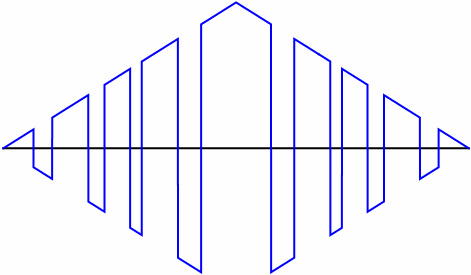
What we see is the energy ‘flipping’ back and forth between positive
and negative, while preserving the underling magnitude of the
triangular shapes.
This flipping action occurs millions of times over each triangular
segment. The slopes of the transitions are extremely
steep. Often there is no discernible zero-point between a
positive-to-negative change. Why it does this is
unknown. But we can figure out the ‘rules’ of when it happens
and this is what will be discussed.
Let’s refer to each triangular segment as an energy
partition. There are four equal-width partitions between each
pair of kill points, and their average width is 0.00016 semitones.
Each partition is subdivided into what will be called
segments. The dividing lines of these segments are determined
by exact fractions. The fractions are described by a
numerator divided by a denominator.
The numerator will either be 1 or a combination of the prime numbers 2,
3, 5, and 7. You can specify any combination of these
multiplied together.
E.g. 2*2*2*3*5*5*7 = 4200.
The only restriction is that their product cannot be greater than the
denominator because the fraction must be less than one.
The denominator is more complicated. It is composed of the
prime numbers 2, 3, 5, and 37. That last one, 37, is
certainly unusual, but that’s how it is.
There are some restrictions on the denominator. You can only
have a maximum of:
12 lots of 2
7 lots of 3
4 lots of 5
2 lots of 37
This would suggest the largest denominator is 2^12 * 7^3 * 5^4 * 37^2,
except there’s a further restriction, which is that is the sum of
powers cannot be more than 19. Therefore the smallest
denominator is 2 and the largest possible denominator is
2^6 * 3^7 * 5^4 * 37^2 = 119760120000
Because 6+7+4+2=19
Using these rules, the simplest fraction would be 1/2=0.5
The smallest would be 1/119760120000=8.35*10^-12
The largest would be (5^3*7^5)/(2^9*3*37^2) = 2100875/2102784 = 0.999092
Taking into account all possible combinations of denominators and
numerators, and being careful to avoid duplicate fractions (due to
common factors in both numerator and denominator), we can generate a
total of 36098 unique fractions. These fractions describe the
boundaries between segments. So we need to sort those
fractions into ascending order.
This will subdivide our energy partition into 36099 segments.
The segments are not uniformly distributed - in fact half of them are
located below 0.01. Their average width is 0.000028 and the
widest is 0.001.
Each energy partition is subdivided by these segments in exactly the
same manner: from the zero/kill point to the peak. That means
the segments will be arranged in reverse when the partition slopes from
a peak down to a zero/kill point.
The divisions then alternate between positive or negative, with the
first division being negative, the next being positive, etc., right
through to the final one being positive. This positive-negative
sign is then used in determining the energy flip sign
of the note.
Subdivisions
It would be nice to announce that this is where the complexity ends and
we can report the ‘flip sign’ as the result. Unfortunately,
it doesn’t end there. Each division is further subdivided
into thousands and sometimes up to a million subdivisions, each of
which causes the sign to flip back and forth between positive and
negative.
To understand how each segment is subdivided we must distinguish the
segments into five different types. This type will be based
on what is in the denominator of the fraction describing the upper
boundary of the segment. It is done as follows:
If the highest factor in the denominator is 2 or 3, the type is 1.
If the highest factor in the denominator is 5, it’s type 2.
If the highest factor in the denominator is 37 and the sum of
powers is odd, it’s type 3.
If the highest factor in the denominator is 37 and the sum of
powers is even, it’s type 4.
If the segment is at the very end, i.e. the upper boundary is 1, it’s
type 5.
The segments are subdivided into parts of equal width as follows:
Type 1 is subdivided into one million (1000000) parts.
Type 2 is subdivided into one hundred thousand (100000) parts.
Type 3 is subdivided into one million (1000000) parts.
Type 4 is subdivided into one thousand (1000) parts.
Type 5 is not subdivided.
With each subdivision, the energy sign alternates, with even
subdivision numbers yielding a negative sign, and odd subdivisions
yielding a positive sign.
Not all subdivisions are included. The ones that are included
depend on both the segment type and the segment sign.
For type 1 and positive segments, the subdivision fractions run from:
0.000001, 0.000002, 0.000003, …
etc., in increments of 0.000001, all the way to
… 0.999973, 0.999974, 0.999977, 0.999978.
For type 1 and negative segments, the subdivision fractions run from:
0.000001, 0.000002, 0.000003, …
etc., in increments of 0.000001, all the way to:
… 0.999914, 0.999919…
After that they continue only with fractions ending in 1, 2, or 9:
… 0.999921, 0.999922, 0.999929, 0.999931, 0.999932, 0.999939,
etc., all the way to:
… 0.999991, 0.999992, 0.999999
For type 2 and negative segments, the subdivision fractions ending in
0,1,2,5,6,9. I.e:
0.00001, 0.00002, 0.00005, 0.00006, 0.00009,
0.00010, 0.00011, 0.00012, 0.00015, 0.00016, 0.00019, …
etc., all the way to:
… 0.99990, 0.99991, 0. 99992, 0. 99995, 0. 99996, 0. 99999
For type 2 and positive segments, the subdivisions include fractions
ending in 0,1,2,5,6,9. But when the second last digit is 9, the
fractions end with 0,1,4,7. I.e.:
0.00001, 0.00002, 0.00005, 0.00006, 0.00009,
0.00010, 0.00011, 0.00012, 0.00015, 0.00016, 0.00019, …
etc., and here is a section where the second last digit is 9:
… 0.00090, 0.00091, 0.00094, 0.00097,
etc., and then it ends with fractions ending in 0,1,8. I.e:
0.99975, 0.99978, 0. 99980, 0. 99981, 0. 99988, 0. 99990, 0. 99991, 0.
99998
For type 3 and negative segments, all fractions are included:
0.000001, 0.000002, 0.000003, … 0.999999
For type 3 and positive segments, all fractions are included but it
instead ends with:
0.999975, 0.999977, 0.999978, 0.999987, 0.999988, 0.999997, 0.999998
For type 4 and negative segments, it starts at 0.019.
Everything above 0.000 and below 0.019 has a positive flip
sign. After that, the subdivisions include fractions ending
in 0,1,2,5,6,9. I.e.:
0.000, 0.019,
0.020, 0.021, 0.022, 0.025, 0.026, 0.029,
0.030, 0.031, 0.032, 0.035, 0.036, 0.039, …
etc., all the way to:
… 0.990, 0.991, 0.992, 0.995, 0.996, 0.999
For type 4 and positive segments, it also starts at 0.019.
Everything above 0.000 and below 0.019 has a positive flip
sign. After that, the subdivisions include fractions ending
in 0,1,2,5,6,9. But when the second last digit is 9, the
fractions end with 0,1,4,7. I.e.:
0.000, 0.019,
0.020, 0.021, 0.022, 0.025, 0.026, 0.029,
0.030, 0.031, 0.032, 0.035, 0.036, 0.039, …
etc., and here is a section where the second last digit is 9:
0.190, 0.191, 0.194, 0.197, …
etc., it then ends a bit differently:
… 0.990, 0.991, 0.992, 0.999
For type 5, the entire segment is considered positive.
Interactive App
To assist with this, an interactive application is provided:
Calculate Note Energy Flips
(opens in new tab)
This takes a fractional value as input and determines whether it
corresponds to a positive, negative, or zero flip sign. It
starts by calculating the segment fractions boundaries and segment
types. It then locates the input fraction within the segments
list. It then calculates the subdivision corresponding to the
type and the location within the subdivision. And from this
it determines the flip sign. The JavaScript can be viewed and
followed in debug mode to see exactly how the calculations are done.
Examples
Let’s look at some examples. We will use a partition that
runs from 4.834236543846192 (a kill point) to 4.838655592449876 (a
positive peak), which means it is upward sloping (from 0 to
1). It has a width of 0.0044 semitones and is the widest
partition there is. We can describe a location within this
range using the formula:
note = 4.834236543846192*(1-frac) + 4.838655592449876*frac
Where frac is a fraction that goes from 0 to 1 and note is the
resulting note. We’ll try a few sample values:
If frac = 1/2, note = 4.8364460681480335
If frac = (3*7)/(5*5), note = 4.837948544673287
If frac = (2*2*3*5*7)/(37*37), note = 4.835592278260763
If frac = 11/17, note = 4.837095928236812
In the first three examples, frac is made up of the ‘approved’
primes. I.e. the numerator uses only 1,2,3,5,7, and the
denominator uses only 2,3,5,37. But the last example, 11/17,
has invalid primes. Thus when listening to the first three,
and alternating between that note and note 0, they will sound equal,
just like zero points.
But the last one won’t. The last sounds positive, i.e. zero
is base. Let’s look at that in more detail.
The fraction 11/17 = 0.6470588235 and sits between the segment fraction
3^11/(2^3*5^2*37^2) = 0.6469941563, and the segment fraction
3^4*5^2*7/(2^4*37^2) = 0.6471420745.
The first of these fractions is at location 33956 in the list of sorted
segment fractions (where the first entry on that list is position
0). 33956 is an even number and this is considered a negative
segment (odd numbers are considered positive segments).
The second of these segment fractions has 37 in the denominator and the
sum of the powers is 4+2=6, which is an even number.
Therefore this is a type 4 segment.
Next we need the subsection fraction, which tells us how far along
11/77 is between the two segment fractions. This can be
calculated:
(11/17-0.6469941563)/(0.6471420745-0.6469941563) = 0.43718228
As mentioned, type 4 negative segments are divided into 1000
sub-segment fractions ending with the digits 0,1,2,5,6,9.
Therefore the above fraction 0.43718228 sits within this sub-list:
0.430, 0.431, 0.432, 0.435, 0.436, 0.439
It sits between 0.436 and 0.439. We take the lower of these:
0.436. The last digit 6 is an even number, which corresponds
to a negative flip sign (odd numbers have positive flip signs).
Thus we have a negative flip sign. But it’s also a negative
segment sign. So we need to take the opposite. We
multiply these signs and end up with a positive flip sign.
Next we multiply the multiply that by the partition energy of the
note. The note sits within a positive partition, with the
peak having an energy of +1. We thus multiply that energy
sign of +1 with the flip sign of +1, and conclude the note has a
positive energy, specifically of 0.6470588235.
Negative partition ranges
The next thing to mention is that there are certain ranges where the
calculated energy flip sign is the opposite of the actual
sign. Specifically these four ranges:
1.9999601364472614 to 2.1534418198883722
2.3518022762922395 to 2.6335189726123565
3.3873364831478203 to 4.3810914676540955
4.3928319362585370 to 4.5671317321705080
Notes within these ranges will have the opposite energy to what’s
expected. For example, consider the note 4.4. It
sits within the kill-point 4.400100110597173 and the negative peak
4.39992973597759. It’s fractional position within this range
is 0.587591024, which calculates as a positive flip sign.
Therefore the note should sound negative, but instead it is positive
(relative to note 0).
To cater for this we need to introduce a concept of ‘partition
sign’. Notes within those ranges will have a partition sign
of -1, and all others will have +1. We then multiply the flip
sign by this partition sign to correct it.
But there is an exception to this rule, which is that it doesn’t apply
to segment type 3, just the other types: 1, 2, 4, and 5.
Also worth mentioning that the above ranges correspond to kill points,
specifically:
12*ModH[Log2[189]^8]*2^(-11/8) to
12*ModH[Log2[883]^4]*2^(37/32)
12*ModH[-Log2[77]^8]*2^(-11/16) to
12*ModH[Log2[253]]*2^(-11/32)
There’s one other note range that has special treatment. It’s
the range surrounding note 3, specifically:
2.999999999999996 to 3.000000000000005
Everything within that range is forced to have a positive
sign. As mentioned in the previous article, note 3 gets
special treatment. It should be a kill point but is given an
exemption and this range appears to define that exemption.
Lower vs Upper half-octave
The flipping action described here only applies to the lower
half-octave, not the upper half. That means when comparing note 0
to a note above 6, we don’t need to do any flipping calculations – i.e.
the flip and partition sign is 1. This is also true when there
are notes in the upper octave. I.e. when comparing a note less
than 6 to note 0, and there are one or more notes above 6, we don’t do
any flipping calculations, and the flip and partition sign is 1.
An important revelation from this is that the upper and lower
half-octaves will not be mirror images of each other. Suppose we
have note x in the lower half-octave. If x has a
negative flip sign and a positive partition sign, or a positive flip
and a negative partition sign, then notes x and 12-x
will have the same energy value, instead of being negatives of each
other. For example, notes 3.4 and 8.6 are mirrored around note 6,
but both have the same negative energy value.
Precision of flip points
As mentioned, the transition between flip regions is very
sudden. Sometimes a zero point is audible at the transition,
but if the partition is narrow, it will just switch from positive to
negative. It can be heard that partitions with a negative
sign or with widths below 0.00010753 semitones don’t have a zero point,
which means 99% of partitions don’t have one.
But how precise are they? Put another way, how small a note
change is required to be detected when crossing a flip point.
As it happens, a very small one indeed! Take the following
four notes:
4.866680303832028 positive
4.866680303832029 zero
4.866680303832030 zero
4.866680303832031 negative
These sit in the partition that runs from 4.8670439546989469 (a kill
point) to 4.866679973393758 (a peak), and those four notes sit on the
boundary of the highest segment (of type 5).
Careful listening reveals that:
The first one, ending in 28, is positive with respect to note 0; i.e. 0
is base
The second, ending in 29, has equal energy with note 0; i.e. neither
are base
The third, ending in 30, has equal energy with note 0; i.e. neither
are base
The forth, ending in 31, is negative with respect to note 0; i.e. ‘31’
is base
Tips:
. It is sometimes difficult to distinguish between positive and
negative, but usually easy to distinguish between zero and non-zero.
. If this range doesn’t work for you, try moving it up or down by
changing the last digit, or widening it to end with 27,29,30,32.
These four notes are extremely close together. They differ
by 10^-15 semitones, or one quadrillionth of a semitone. By
all accounts, this shouldn’t be possible, yet somehow it is.
One benefit of this accuracy is that we can use it to fine-tune
observations. The ‘additional kill ratios’ shown in Table 3,
for example, are given to very high accuracy because they were matched
up with flip points.
The 12-tone scale
The final point to consider is how does this affect notes in the
12-tone scale? Surprisingly, it doesn’t. Each note,
from 1 to 5, manages to avoid landing on a negative flip
region. Given that negative flip regions occupy 50% of the
‘landscape’, the probability of all five semitones in the lower
half-octave avoiding a negative region is 1 in 32. In other
words, unlikely.
But this avoidance may be ‘deliberate’ so to speak. Notes 2
and 4 sit within the negative partition ranges mentioned above, and
should have a negative flip sign. But they are also on a
segment of type 3, and the negative partition doesn’t affect type 3.
Note 3 also calculates as a negative flip sign. But note 3
also sits within a special ‘exclusion zone’ that forces the flip sign
positive.
As mentioned in the previous article, the 12-tone scale appears to get
special treatment. Thus these special rules exemptions may
have been added to ensure that the 12-tone notes are unaffected by
flipping.
|